
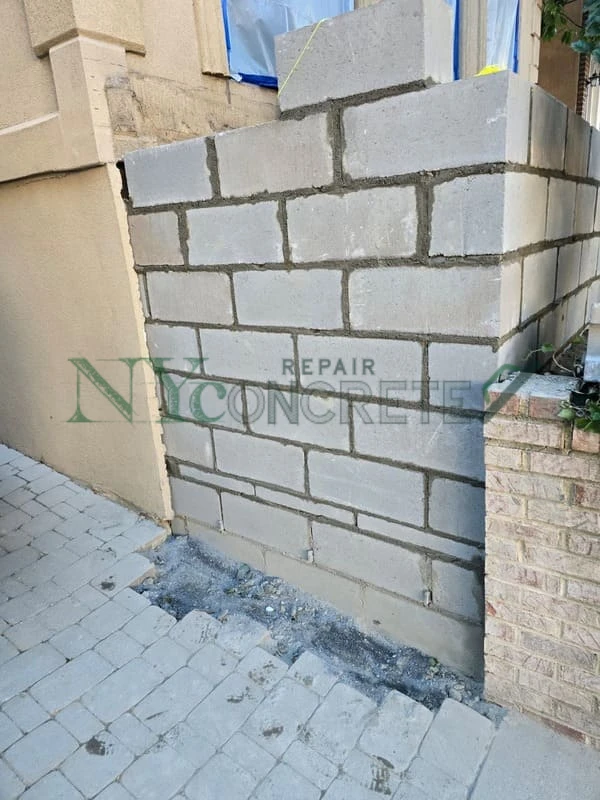
Concrete Retaining Wall Contractor in NYC
A retaining wall isn't just holding back dirt. It's holding back pressure that builds every time it rains.
We've built and repaired retaining walls across Manhattan, Brooklyn, Queens, and the Bronx for 25 years, and most calls start the same way: a wall that used to look fine now has a lean, a bulge, or a crack that keeps getting wider.
Get a Free Estimate: +1-718-395-3030
Retaining Wall Work We Handle
Sloped backyards, raised beds, and property line grade changes all need walls built the right way. Here's what we take on most:
- New retaining wall construction
- Repairing leaning, bulging, or cracked walls
- Rebuilding walls that have partially collapsed
- Adding or fixing drainage behind existing walls
- Small garden and terrace retaining walls
- Walls supporting driveways or parking areas
Every yard has a different slope and soil type, so tell us what your property looks like when you call, even if it doesn't match this list exactly. Where a wall ties into brick or block, our masonry crews handle that side of the work too.
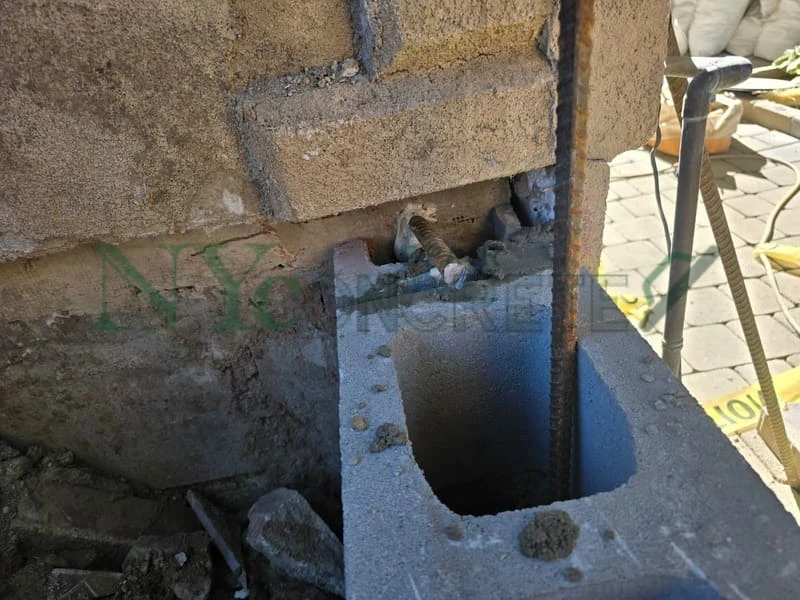
What Actually Makes a Wall Fail
Most retaining wall problems come down to water, not the concrete itself. Wet soil pushes against the back of a wall constantly. Engineers call this hydrostatic pressure. A wall without proper drainage is fighting that pressure with no way to relieve it.
Over time, that pressure wins. The wall leans, then bulges, then cracks.
NYC's freeze and thaw cycles speed this up, since trapped water expands as it freezes and pushes harder from the inside. A wall that's leaning even slightly usually means this process has already started.
How Much Does a Retaining Wall Cost in NYC?
Here's what our retaining wall work typically runs:
| Type of Work | Typical Price Range |
|---|---|
| Crack repair (structurally sound wall) | $800 – $3,000 |
| Drainage retrofit behind existing wall | $2,500 – $9,000 |
| Weep hole installation and backfill correction | $1,500 – $5,000 |
| Wall stabilization (leaning, no rebuild) | $4,000 – $15,000 |
| Small garden or terrace wall (under 4 ft) | $60 – $120 per linear ft |
| Standard concrete wall (4–6 ft) | $150 – $300 per linear ft |
| Engineered wall (over 6 ft) | $300 – $600 per linear ft |
| Partial rebuild after collapse | $8,000 – $30,000 |
| Full wall replacement | $15,000 – $60,000+ |
| Engineering plans and DOB filing | $3,000 – $12,000 |
| Excavation and site access | $2,000 – $10,000 |
The final cost depends on wall height, soil conditions, drainage requirements, and whether engineering and DOB approval is required, so we give you a written itemized price after seeing the property in person.
Why This Isn't a DIY-Adjacent Job
A failing retaining wall is a structural problem, not a cosmetic one. If a wall gives way, it can take a section of yard, a fence, or a neighboring property with it. That's why we look at drainage and soil, not just the visible crack, before saying what a repair needs.
We're licensed through the NYC Department of Consumer and Worker Protection and fully insured on every job. Our crews follow OSHA safety rules on every site.
Twenty-five years of building these locally means we know which soil types need extra drainage work before a wall goes in.
When Does a Retaining Wall Need a Look?
- The wall leans outward, even slightly
- Cracks are horizontal or run in a stair-step pattern
- Water seeps through the wall face after rain
- The ground behind the wall has sunk or pulled away
- Bulging is visible partway up the wall
- Sections of the wall have already shifted or separated
A wall that's perfectly straight with no seepage is probably fine. Any of the signs above is worth a call before the next heavy rain.
How We Approach Your Project
- Free onsite visit. We look at the slope, soil, and existing wall to find what actually drives the damage.
- Drainage assessment. We check how the ground behind the wall holds water. This decides how much drainage the wall needs, which matters more than the concrete for how long it lasts.
- Written price and plan. You get a real number before work starts. Taller walls, usually over four feet, often need Department of Buildings approval and an engineer's plan. We check this and give you the timeline upfront.
- Permits, if required. We file with the DOB and coordinate any engineering review, so you're not handling that paperwork yourself.
- Footing and excavation. We dig to the proper footing depth. This step gets rushed on cheaper jobs, and it's usually the first thing to fail when it is.
- Drainage installation. Gravel backfill, a drainage pipe, and weep holes go in behind the wall. This is what relieves water pressure over time instead of letting it build against the concrete.
- Wall construction. We build the wall and compact backfill in stages, so it settles evenly instead of shifting later.
- Final walkthrough. We walk the finished wall with you and point out the drainage features so you know what to expect over time.

Get Your Free Onsite Estimate
A leaning or cracked wall rarely fixes itself, and it gets more expensive the longer it waits.
Call for a free onsite estimate. We'll inspect the wall, explain the cause, and give you a straight price.
Call Now: +1-718-395-3030
Frequently Asked Questions
More urgent than most people assume. A lean means the wall is already losing the fight against pressure behind it. We'd rather you call early than wait for a collapse.
Depends on the cause. If the wall is intact but drainage has failed, we can often fix the drainage and stabilize it without a full rebuild. If the structure has shifted or cracked through, a rebuild is the safer route.
Those are likely weep holes, and they're supposed to be there. They let water drain out instead of building up pressure. If water isn't coming through and the wall is bulging, drainage has probably failed and water is trapped.
It varies by site, but NYC generally requires engineering plans above four feet. We'll confirm the exact requirement for your property during the visit.
Yes, especially older trees close by. Roots can add pressure from a different direction than soil alone and sometimes lift or crack a wall's base. Mention nearby trees when you call.
Small garden walls often take a few days. Taller walls needing permits and engineering review take longer, mostly due to approval time rather than construction. Our estimator will give you a realistic schedule.