
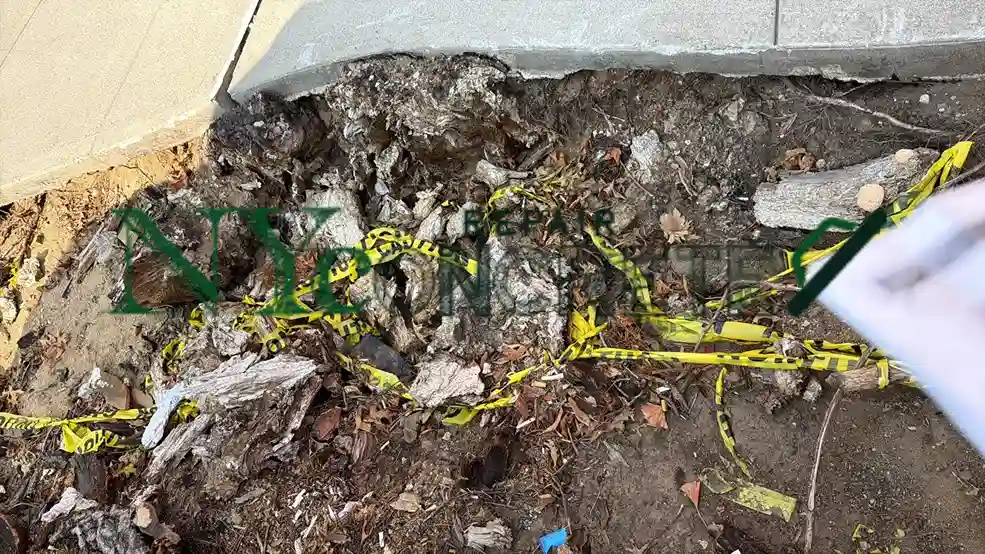
If a letter from the NYC Department of Transportation just showed up, the page you need to study is the Preliminary Inspection Report, the sketch attached to your Notice of Sidewalk Violation. It shows which sidewalk squares, known as flags, failed inspection, why each one failed, and roughly how much concrete has to go. According to NYC DOT, every flag marked with a number on that sketch must be replaced and its defect corrected. Below, we'll walk through the report box by box so you know exactly what you're looking at.
What's in the Envelope and Why It Matters
A DOT sidewalk packet usually contains the Preliminary Inspection Report, the Notice of Violation, and paperwork explaining your responsibilities as an owner. There's no fine attached, but the City's property owner's guide explains that a copy of the notice is filed with the County Clerk and stays there until the City confirms satisfactory repairs. That record can complicate a sale or a refinance, so it's worth dealing with quickly.
You may wonder why your block was picked. DOT says it chooses inspection sites based on factors like reported injuries and filed complaints. Owners can also be held liable for injuries caused by a poorly maintained sidewalk under Section 7-210 of the NYC Administrative Code.
The Top of the Report, Box by Box
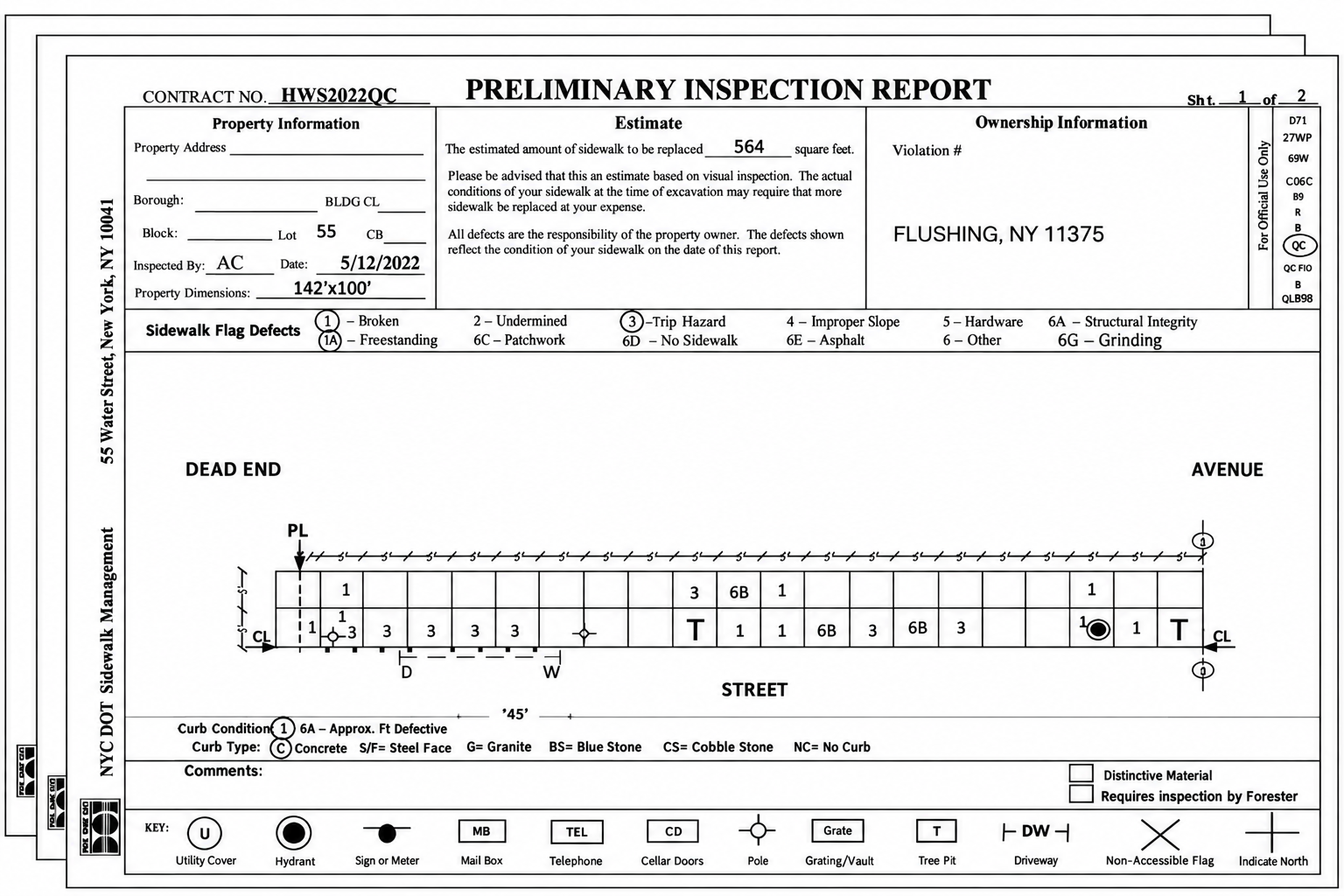
Contract Number and Sheet Count
The contract number in the upper left (HWS2022QC on the sample form) is an internal reference for the inspection program. Glance at the upper right, too. A label like "Sheet 1 of 2" means your sidewalk continues onto another page, and the flags on that second sheet count just as much.
Property Information
This block lists the address, borough, building class, block and lot, the inspector's initials, the inspection date, and the lot dimensions (142' x 100' in our example). Compare the block and lot with your deed or with the City's ACRIS records. If the numbers or dimensions don't match, you may be looking at someone else's violation.
The Estimate
Here the inspector writes the approximate square footage to be replaced, 564 square feet on the sample. The form itself warns that this figure comes from a visual check only. Once contractors start breaking out concrete, the real condition may call for more flags, and that extra work is still the owner's cost.
Ownership Information and Violation Number
The right-hand box holds the owner's mailing details and the violation number. Write that number down somewhere safe. You'll need it for 311 requests, your permit, and the final dismissal inspection.
Decoding the Sidewalk Flag Defect Codes
The row of codes across the middle of the form ties directly to the substantial defects listed in Administrative Code §19-152 and DOT's rules at §2-09. Here's how each one translates.
|
Code |
Label on the form |
What it means |
|
1 |
Broken |
A flag cracked badly enough that pieces could loosen or be pulled out. |
|
2 |
Undermined |
A visible void under the flag, or a loose flag that rocks or seesaws when stepped on. |
|
3 |
Trip Hazard |
A height difference of half an inch or more between neighboring flags, or a surface hole at least one inch across in every direction and half an inch deep. |
|
4 |
Improper Slope |
A flag that doesn't drain toward the curb and holds water, or one that must be replaced to fix drainage. |
|
5 |
Hardware |
Utility caps, gratings, hatches, or cellar doors that aren't level with the surrounding concrete. |
|
6C |
Patchwork |
A flag patched in a way that leaves a defect behind. |
|
6D |
No Sidewalk |
Missing flags, or a stretch where a sidewalk was never built. |
|
6E |
Asphalt |
A flag made partly or fully of asphalt or another unapproved, non-concrete material. |
|
6A, 6B, 6G, 6 |
Structural Integrity, Freestanding, Grinding, Other |
Inspector categories that aren't spelled out word for word in the code. If your sketch uses one, confirm the specifics with DOT through 311 before work starts. |
A single flag can carry more than one number. On the sample, one flag reads "1" above "3," meaning it's both broken and a trip hazard.
Reading the Sidewalk Sketch
Street Names, Property Lines, and Measurements
The grid is a bird's-eye view of your frontage. Street labels (DEAD END, AVENUE, and STREET on the sample) orient the drawing, while PL marks your property line and CL marks the curb line. Letters and dimensions under the grid, such as the 45-foot note in our example, record features and distances the inspector measured. An empty flag passed inspection, so you only need to worry about the numbered ones.
The Symbol Key
The legend along the bottom explains the icons on the sketch: utility cover (U), hydrant, sign or meter, mailbox (MB), telephone (TEL), cellar doors (CD), pole, grating or vault, tree pit (T), driveway (DW), non-assessable flag (an X, which won't be charged to you), and a north arrow. These landmarks are your best tool for confirming the sketch really shows your property. DOT recommends checking the width, trees, signs, utility caps, and cellar doors against what's actually out front.
Curb Condition and Curb Type
Just below the grid, you'll find curb notes. A circled code here flags curb defects along with an approximate length in feet. The curb type line uses C for concrete, SF for steel face, G for granite, BS for bluestone, CS for cobblestone, and NC for no curb.
The Two Checkboxes
"Distinctive Material" signals that your sidewalk uses a nonstandard surface, which can affect how repairs are matched. "Requires inspection by Forester" means a street tree is involved. In that case, look into the Parks Department's Trees and Sidewalks Program before anyone touches a root.
Deadlines and What to Do Next
You have 75 days to make repairs, counted from the day you received the notice by certified mail. After that, DOT's rules allow the City to do the work itself and bill you for it.
If you think the defects simply aren't there, request a re-inspection through 311 Online within the next 75 days. DOT explains that a different inspector, one without access to the original report, will visit, and you'll get mail notice at least five days ahead. If the sketch doesn't match your property at all, ask 311 for a Sidewalk Violation Search instead.
Repairs require a DOT sidewalk permit, and the owner's guide lists the fee as $70 for every 300 linear feet of sidewalk on a property. When the work is done, the City's dismissal checklist says expansion joints must sit at least every 20 linear feet, at each property line, and where the sidewalk meets the curb. You'll then schedule a dismissal inspection through 311 with your permit number, address, block and lot, and violation number. You can follow the violation's status on the City's Sidewalk Management Database.
Get Your Sidewalk Violation Cleared With NYC Concrete Repair
A Preliminary Inspection Report is easier to read once you know the codes, but the repair still has to be permitted, built to DOT specifications, and signed off. NYC Concrete Repair handles the whole process, from reviewing your sketch and pulling the permit to replacing the flagged concrete and preparing your sidewalk for the dismissal inspection. Reach out to NYC Concrete Repair today for an estimate, and get that violation off your property record before the 75-day clock runs out.