
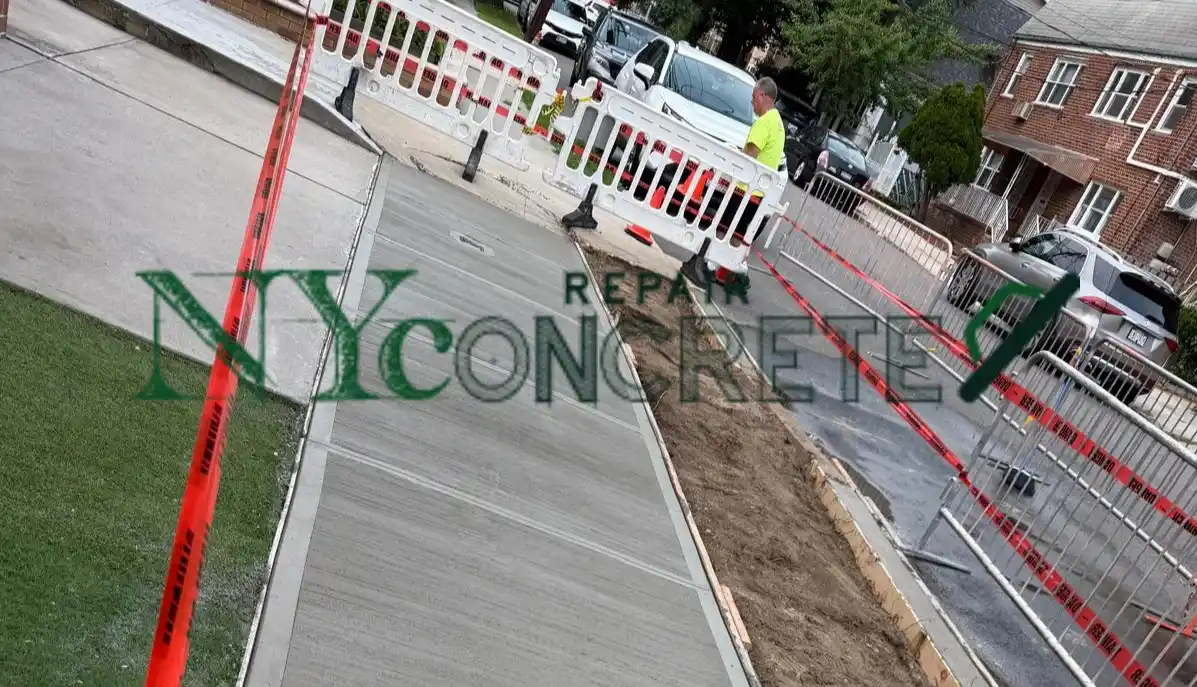
If you're planning any sidewalk work in New York City, skipping the permit step will cost you more than the $70 fee ever could. Whether you're pouring a new slab, patching a violation, or setting up a sidewalk shed, the NYC Department of Transportation requires a permit before a single piece of concrete gets touched. Skip it, and DOT can shut the job down, hit you with fines, and force you to redo the entire application process from scratch, this time with a delayed project and an inspector paying closer attention.
This guide walks you through the actual DOT sidewalk permit application from start to finish, so you know exactly what's being filled out and why, even if a licensed contractor is the one submitting it.
When You Actually Need Sidewalk Work Permit
DOT doesn't just require a permit for full sidewalk replacements. You need one any time your project touches the public right-of-way in front of a property, including:
-
Building or repairing a sidewalk
-
Installing a structure over the sidewalk, like a canopy or shed
-
Placing furniture or equipment on the sidewalk
-
Storing repair materials or tools on the sidewalk
-
Blocking any part of pedestrian access, even temporarily
The common thread is simple: if the work changes how people move through or use that stretch of sidewalk, DOT wants a permit on file first.
Only a Licensed Contractor Can File
Here's the part that trips up a lot of homeowners: you can't apply for this permit yourself. DOT only issues sidewalk permits to contractors who hold a valid Permittee ID, which means the license lives with the contractor, not the property owner. If you're managing a repair, your job is to hire a licensed contractor and let them handle the filing. They'll gather your property details, fill out the application, and submit it on your behalf.
This isn't just a bureaucratic hoop. A licensed contractor already knows DOT's formatting expectations, has an active Permittee ID on record, and is far less likely to get the application kicked back for a missing field.
Breaking Down the Application, Section by Section
The DOT sidewalk permit form is split into six sections. Here's what goes into each one and why it matters.
Section A covers the contractor's information.
This includes their five-digit Permittee ID, business name, mailing address, phone number, and email. DOT uses this to confirm the person filing is actually licensed to do the work, so nothing here should be left blank or filled in with placeholder info.
Section B is where the project itself gets described.
This is the longest section, and it includes the borough, an OCMC file number if one already exists, the pavement type (usually concrete), any related Department of Buildings permit number, and the property's house number and street. If the work is happening on a different street than the property address, that gets noted separately, along with the two cross streets nearest the site.
From there, the form asks for the purpose of the work, how many openings or cuts will be made, the total area size, and the frontage length along the property line. You'll also list a proposed start and end date, though DOT reserves the right to adjust these based on scheduling conflicts elsewhere in the area. If the work falls near a corner or crosswalk, there's an additional question that needs to be answered according to DOT's contractor guidance.
Section C is a checklist of permit types.
Your contractor marks which categories apply, whether that's a straightforward sidewalk repair or something like a roadway cut. This section is short, but getting it wrong can misclassify the entire application.
Section D asks for a hand-drawn sketch of the work zone.
Even though most of the application can be completed digitally, DOT still requires a physical drawing that shows the street name, cross streets, a north arrow for orientation, sidewalk and roadway width, and the exact spot where work will happen. This has to be printed and drawn by hand before submission, no exceptions.
Section E is reserved entirely for DOT staff.
Nothing should be written here by the applicant. It exists for internal notes and permit conditions that DOT adds during processing.
Section F is the sign-off.
The person submitting the form, usually the contractor or an authorized representative, prints their name, provides a phone number, and signs by hand. DOT does not accept digital signatures on this section, so a physical signature and date are required before the application goes in.
What the Permit Costs
A standard sidewalk repair permit runs $70, and that fee covers up to 300 linear feet of sidewalk on a single property. It includes both the administrative processing fee and the inspector's visit needed to close out the permit once work is finished.
One detail worth flagging: corner properties often need two separate permits. If your sidewalk wraps around a corner lot and repairs are needed on both street-facing sides, DOT treats that as two distinct permit applications, not one combined filing.
Applying by Mail
If you're filing by mail rather than in person, the process has a few extra steps worth knowing:
-
Complete the application and sign it. If the work is being done in response to a sidewalk violation, include that violation number in the "for the purpose of" field.
-
Get the Affidavit of Ownership notarized. This document confirms you're the legal owner of the property tied to the permit, and it has to be notarized before submission.
-
Include a certified check for $70, made payable to NYC DOT, along with a stamped, self-addressed envelope so the approved permit can be mailed back to you.
Once everything is assembled, it gets mailed to:
New York City Department of Transportation
Permit Management & Construction Control
Permit by Mail
55 Water Street, Concourse Level,
New York, NY 10041
DOT reviews the application for completeness and accuracy before approving it, and the finished permit goes out to the address provided on the envelope.
A Few Things That Speed Up Approval
-
Confirm your contractor's Permittee ID is active and current before filing, not after
-
Double check every field in Sections A and B for accuracy, since incomplete applications get sent back
-
Make sure the hand-drawn sketch in Section D is clear and includes all required elements
-
Submit early, since DOT can shift proposed work dates based on other scheduled projects nearby
-
Leave Section E blank; it's for DOT use only
Conclusion
The DOT sidewalk permit process has more moving parts than most property owners expect, but none of it is optional. Between the licensing requirement, the six-section application, and the hand-drawn sketch, there's real room for something to go wrong if it's not handled by someone who's done it before. Working with a licensed contractor who understands this process end to end is what keeps a sidewalk repair project on schedule instead of stuck in DOT review.
NYC Concrete Repair takes that off your plate entirely. As a licensed contractor with an active DOT Permittee ID, our team handles the full application, from Section A paperwork to the hand-drawn work zone sketch, so your project stays on schedule instead of stuck in DOT review. If you're dealing with a sidewalk violation, planning a repair, or just want the permit process done right the first time, reach out to NYC Concrete Repair for a straightforward quote and a filing that gets approved without the back-and-forth.